Powerless in Kuala Lumpur
- May 8
- 8 min read
The word of the week is powerless. There’s no preamble to that.
Most backpackers and travel bloggers have one thing in common: we love to share our mountaintop moments. We chase the experience that makes every wrong bus, mosquito bite, and tuk-tuk scam worth it. We climb a mountain (figuratively or literally), and it’s only from the top that we share the view and some of the vulnerabilities along the way.
The Backpackers’ Greatest Hits Album includes “Loneliness,” “Who am I?” and “Changing My Perspective.”

But beneath the clouds is a collection of small moments and mishaps that never make the final edit. On their own, they hardly seem worth mentioning; over several weeks, these micro-frustrations become heavier, a dripping faucet slowly drowning my resiliency.
To paint a better picture, it’s a waiter bringing you chicken pad thai when you asked for seafood because they believe that’s what you actually wanted. It’s ordering the same item as the person in front of you but getting charged more at checkout. It’s a scooter driver taking you to a site outside the city only to tell you that you can't order a scooter home — you’ll have to negotiate a cash deal with them to wait for you. It’s vendors shouting “Mango!” at you so many times a day, you’re starting to believe it’s your name.
And — what has been the heaviest as a solo female traveler — it’s a lot of unwanted attention from men.
The weight of this was most noticeable in Kuala Lumpur. Part of it was my own fault; I booked a hostel in the middle of Chinatown’s busiest street market. Leaving or coming home each day meant walking through rows of tents filled with aggressive vendors selling knockoff Louis Vuitton and fighting for tourist attention. Each morning started and each evening ended with, Hello, sexy lady! You like handbag?
But even once I made it out of the market, an uncomfortable number of drivers, service workers, and strangers on sidewalk curbs would approach me, call to me, and glance at me to the point where I never truly felt alone; I was always in the presence of uncomfortable company.
It was an exhausting reminder of a less empowering reality of identity: I’ve spent hours discovering myself, but how we have to navigate the world largely depends not on how we view ourselves from the inside, but on how we are perceived by others from the outside.
On the outside, I am not an empowered explorer. I am a walking ATM named Mango.
Mango can take a lot of punches. But in Kuala Lumpur (or KL as the cool backpackers call it), my patience reached its limits.
The final straw was pulled at a phone repair shop where I negotiated a great deal for a screen repair. When the work was done, the owner (a middle-aged man) insisted on trading my phone number for the deal he gave me. He wasn't interested in taking no for an answer. After several refusals, he damaged the screen, and there was nothing I could do. I handed him the cash, walked away, and tried to be grateful I still had a working phone at all.
As I walked home, I once again felt the weight of calls and stares, and at last I found the limit on how much harassment I could excuse in a day. In that moment, I wasn't even an empowered explorer to myself; the only thing I wanted to do was run back to my bunk bed and close the curtain.
I just had to walk through a jungle of, Hey sexy lady, you like handbag? to get there.

The Redemption of Kuala Lumpur
The Backpacker’s Guide to the Universe says that when the cities knock you down, look for the mountaintop moment. I sought it everywhere I could in KL: I saw the tallest statue in Malaysia, ate Michelin-recognized plates, and watched Merdeka 118, the second-tallest building in the world, light up at sunset.
But for the first time on my journey, I didn’t find the mountaintop.


Here are three angles of the world's second-tallest building, my favorite of the must-do sites. I think the unicorn horn at the top for extra height is cheating, the building version of wearing high heels, but I'm curious to hear other opinions.

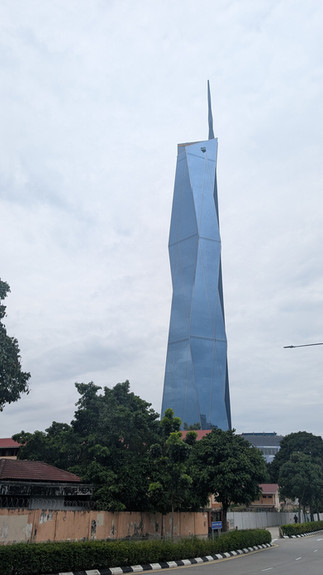



Is the unicorn horn at the top of the second-tallest building cheating?
Definitely
Nope, fair game
To give KL some credit, while I didn't discover mountaintops, I still found some hilltops: wonderful moments that delighted the inner tourist and challenged me in more meaningful ways.
The greatest surprise called my name in Chinatown, just when I wanted to hide in the bunk bed again.
“Megan!”
I spun around to find Kenza, a good friend from George Town. It was the joy I needed to have dinner with an old friend (which in backpacking terms means we’d known each other for a week). We spent the next two days adventuring together, visiting the National History Museum, the water show at the City Center, the Suria mall (basically the NYC of KL), and the famous Petronas Twin Towers for their nightly lights.


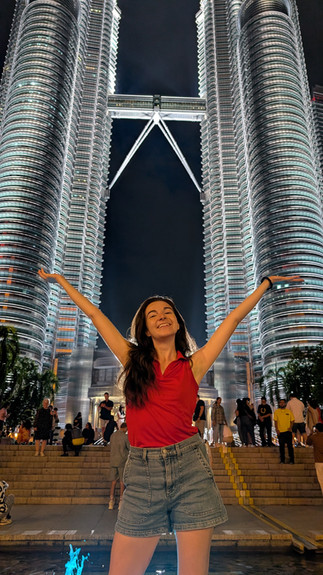

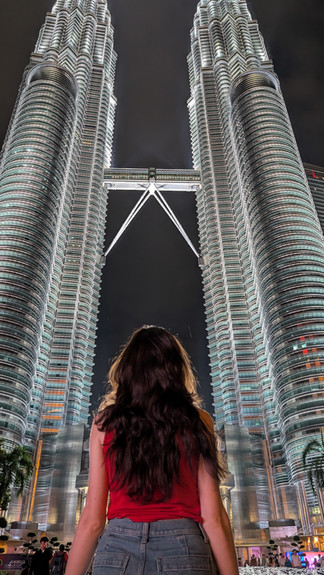

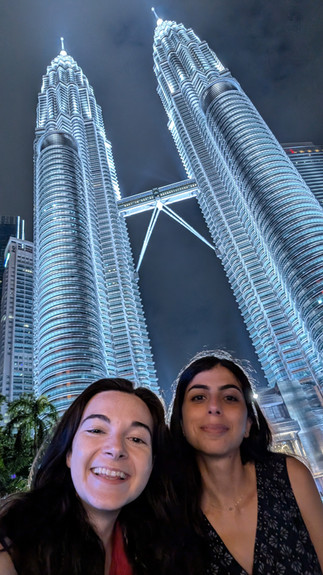
My favorite thing about Kenza is the question she asks after every meal: “So where are we going for dessert?” We are very good at dessert.

The second surprise was Hannah. When I checked in to my hostel, I was looking for nothing more than a few hours to bury my head in the pillow. Instead, I was greeted by a 72-year-old Taiwanese woman in a bucket hat in the bed beside mine.
“Hello!”
At first, my stomach twisted. I didn’t know if I had the strength for another “Where are you from?” conversation. I had men to forget and a mountaintop to find.
However, Hsiu (English name Hannah) was no ordinary backpacker. Within three minutes, I was sitting on my bed across from her, completely captured by her life story. My aim in Malaysia was to study religion, and I just so happened to be roommates with a missionary scholar with three master’s degrees and a PhD in theology. She also studied under John Wimber at Fuller Seminary.
“He led the Vineyard Church,” she said. “Have you heard of the Vineyard Church?”
My head snapped up. I’m loosely familiar. (For those who don’t know me, I’ve been a part of the Austin Vineyard Church for the past four years.)
Whether you believe in God or just coincidences, Hannah was my bunk buddy for a reason.
Over the next few days, we spent hours talking about religion. It’s remarkable how words have the power to be the most depleting or energizing part of our day depending on how we use them; when I thought I had reached conversation capacity, I always found an empty jar to fill with Hannah’s words.

You might be wondering what a 72-year-old woman with three master’s degrees and a PhD is doing in a hostel sharing a bunk bed. To sum it up, the Lord’s work doesn’t pay.
But for me, it was a blessing. Meeting Hannah was the motivation I needed to continue interfaith explorations in Malaysia, which became the most rewarding part of the week.
Church, State, and Women in the National Mosque
There's no better place to start learning about religion in KL than the National Mosque. To enter, you must register, take off your shoes, and make sure you’re covered from head to toe. If you're not, you can borrow a robe for free.
I felt like a purple penguin waddling up the steps to this beautiful structure, but it was worth it to meet Ky, a volunteer who was kind enough to give me a tour of the mosque and answer my questions about Islam in Malaysia.

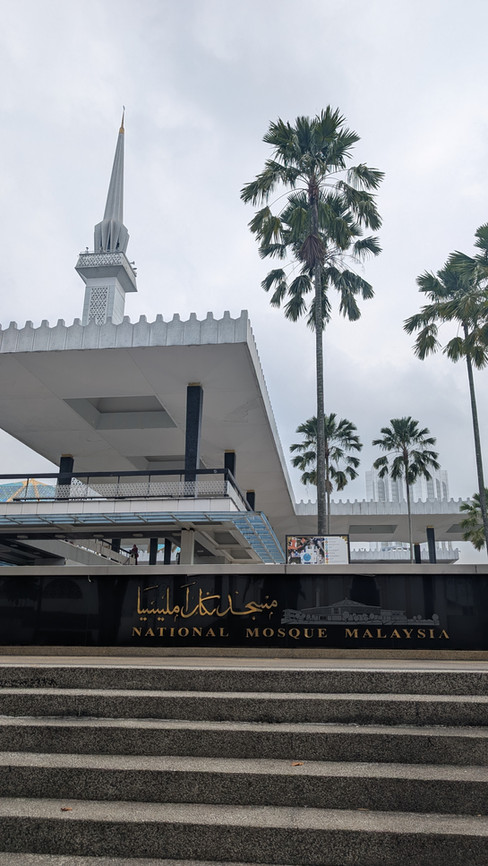


While George Town was a lesson in harmony, Kuala Lumpur shed light on the complex reality of having a national religion alongside a culture of tolerance. For example, while Malaysian law states that anyone can change or leave their religion at any time, the process is more difficult for Muslims. Muslims are bound by an entirely different legal system (Shariah law) in family and civil matters, which means they are granted different — and often more restrictive — freedoms than other religions in Malaysia.
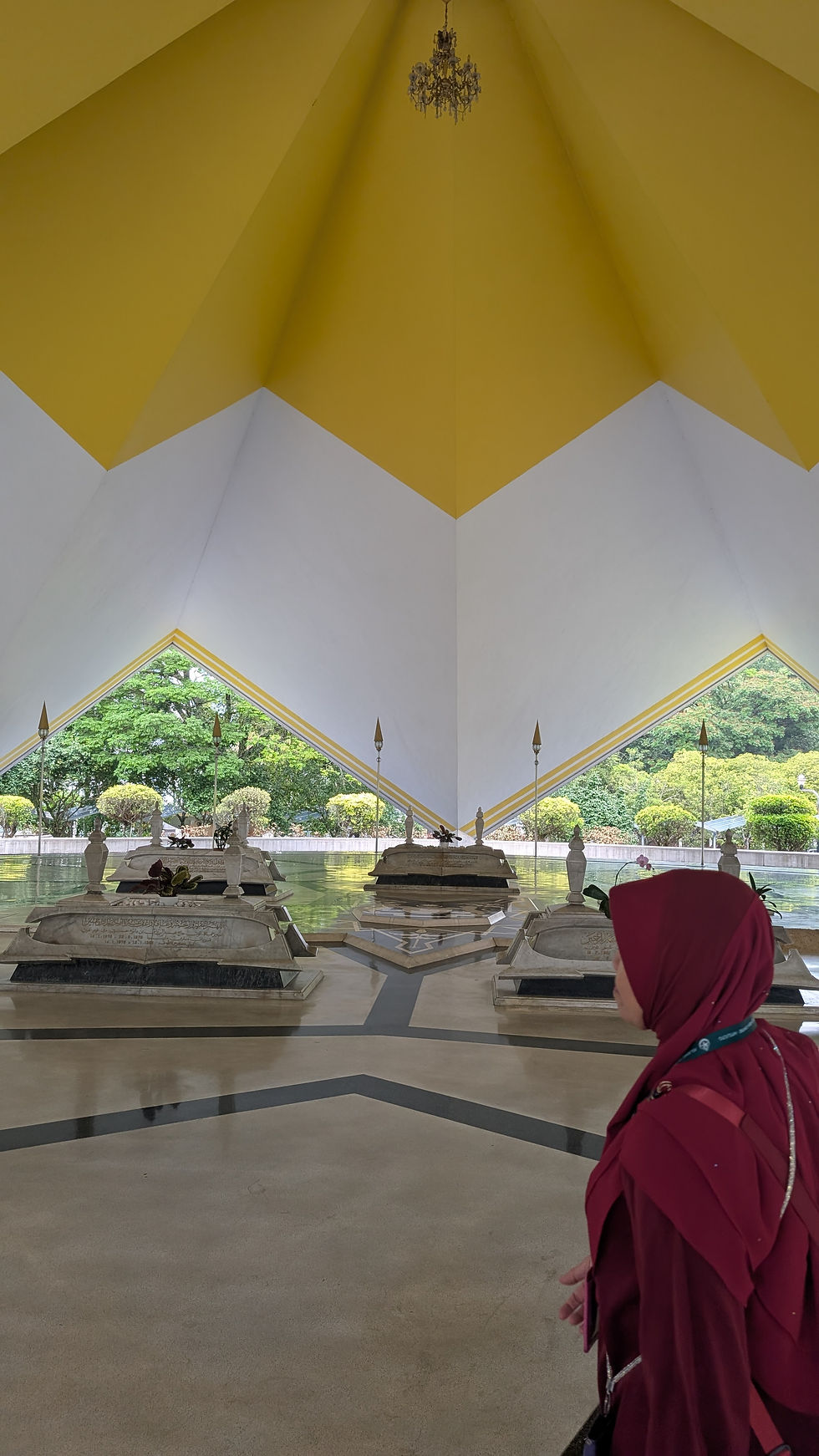
Ky had an infectious personality, and a 15-minute tour turned into two hours at a table discussing religion, culture, and Ky's life. Ky was willing to share her perspective as a Muslim woman in KL, particularly her thoughts on coverings women have to wear.
Ky told me she didn’t used to be Muslim or appreciate the idea of women covering themselves — her legs were her greatest asset. In a word, I’d describe Ky’s younger self as flirty, and she wasn’t shy about sharing her past and present excursions with men. From what I gather, lots of them want to be her “friend,” too.
“You’re from America,” she said. “They have men with blue eyes there.”
But after a motorcycle accident scarred her greatest asset, she realized how much value she placed on her body and wanted to change her mindset. She said men give her much less attention when she's covered, and women feel safer and more free in public. I might not have believed this a few weeks ago, but after some of my encounters as a female traveler — especially in KL — I'm far more open to the idea of covering up to avoid uncomfortable situations with men.

Ky and I ended our conversation around prayer. For Ky, the five daily calls to prayer during Ramadan are a reminder to constantly be in conversation with God and to lean into community. Ramadan is not just about fasting or praying as an individual; it designates a time when the entire faith community draws closer to God together while supporting each other, and this time is respected by the government and neighbors. This strength in community has been remarkably special to watch here in Malaysia. It's an example worth following in any faith or family.
For Ky, prayer has never been more powerful than when she visited Mecca. She told me that when you visit Mecca, you are closer to Allah, and your prayers are more likely to be answered.
I asked her what she prayed for. She looked dreamily to the ceiling.
“A man with blue eyes.”

I feel like I owe Kuala Lumpur an apology; it doesn't deserve the negative review I'm leaving it with. At the end of the day, I discovered several peaks and wonderful moments, even if none of them became mountaintops. Today I'm content with the hilltops and ready to move on.
Next, I'm fighting the urge to return to George Town and am moving on to Singapore, just a few hours away by bus.
I’ve heard many times that Singapore is the most expensive country to visit in Southeast Asia, but my fingers are crossed I can still enjoy it on a backpacker’s budget. Dare we hope. Wish me luck.
Love,
Mango


Comments