Meg's Adventure Roundup Part 2: Bangkok
- Mar 19
- 10 min read
Updated: Apr 2
When I booked a 13-hour budget train from Chiang Mai to Bangkok, I had one naive thought: How bad could it be? I’ve ridden in a public school bus before, so I’ve basically been through the trenches. There were some pros and cons to weigh.
Cons:
No air conditioning in 90-degree southeast Asia
Seats that make the public school bus feel like a treat
Brushing sweaty arms and knees with 3 strangers for 13 hours
Air pollution that will cover your hair, clothes, laptop, and bags in a dusty film that will require multiple showers to make you feel human again
Pros:
A $9 ticket
The pros have spoken. I boarded in Chiang Mai at 6 in the morning and saw the Thai countryside from a dusty train car window.





13 hours later, I arrived in the big city.
I then learned just how big the big city was, and another 2 hours of traffic and trains and accidentally walking through the red light district after that, I reached my hostel.
Welcome to Bangkok.
The Biggest of Bangkok
The word of the week is supersize.
Most of Bangkok’s must-see sights have one selling point: they’re the biggest of that thing you’ve ever seen. The biggest temple, biggest palace, biggest market, biggest mall, biggest Buddha … you name it, they’ve supersized it. Everything might be bigger in Texas, but it is biggest in Bangkok.
By every touristic measure, I had the full Bangkok Experience: I shopped in the outdoor markets, took a water taxi across the skyline, overconfidently ordered a stir fry that was so spicy I cried, and lost $3 to a tuk-tuk scammer.* That’s basically Bangkok Bingo.
*In my defense, the whole scam is an all-day affair that costs people a lot of time and money in the end. I caught on in the first few minutes and threw $3 to bolt as quickly as possible.
Not to brag, but I get a lot of attention from swindlers in big cities. They love to see a woman in a floppy sun hat coming.

But I’m not measuring my trip in tourist terms anymore. Success is now measured in how well my time is serving my values and my goals. My schedule was empty for the first time in my life, and I planned to refill it with every back-burner ambition I've been dying to move to the front now that I have some free time to shape.
But time, like money, requires a budget that I did not take enough time to set.
I had planned to blog every week, do yoga every morning, and finally conquer French. But within a week, I was a hostage once again to my goals, my laptop, and my phone. That’s the problem with time — we are forced to spend it every second, ready or not. In a panic not to waste it, I tend to over-optimistically fill my schedule with commitments that keep me in a perpetual hamster wheel. Turns out even when the wheel around me is removed, I'll build a new one myself.
I was burning out again, somehow still leaving the blog unpublished, the yoga unpracticed, and the French unlearned. By those measures, I am a failure. Je suis un échec.
And in the backdrop of it all was one of the most ambitious cities in southeast Asia spurring me on and inviting me to a new list of once-in-a-lifetime attractions.
But now that I've failed, there's nowhere to go but up. My first priority was making a budget for my time similarly to how I budget my money. I have to accept that some projects may always live on the back burner and find genuine peace with that. The silver lining of Bangkok is that the busier the city, the better the opportunity to practice balance and contentment. If I can do it here, I can do it anywhere.
I took a step away from my phone, minimized the itinerary guides, and am continuing to train my inner tourist to take the backseat and quiet down. It's a constant struggle with that one, but I make sure to reward her with plenty of grilled bananas for good behavior.
This week, balance looks like a morning in a temple and a long afternoon with my notebook. Or a tea to start the day and a night market to end it. A park in the morning, laundry in the afternoon. You get the idea. Turns out, I value writing time and a solid cup of tea more than most tourist attractions. There are plenty of opportunity costs; I could be doing more, seeing more, achieving more. But I finally feel like my schedule is serving me and not the other way around.

And as the week rolls on, I don’t feel like I'm missing out on anything. Whether I spend a week in Bangkok or the rest of my life, there will always be more sights to see and food to eat. The skill is discerning which commitments are worth the yes for me. This is perhaps one of the most valuable souvenirs I'll bring home with me when it’s time to refill my life with work, classes, and pickleball in Texas once more. You might hear me say "no" just a little bit more, but when used thoughtfully, what a wonderful word it can be.
I’m content with my week; I’m ready to move on.
And now, the inner tourist gets a banana.
The Bangkok Experience
Between tea times, I still left plenty of room in the budget for Bangkok adventures. Sometimes the travel guides are right; some of the must-dos are pretty unmissable.
My first stops were the 3 must-see temples of Bangkok. I began with a trip to a temple called Wat Saket, a.k.a. the Golden Mount. While Chiang Mai’s largest temple takes 306 steps to reach the top, Bangkok’s must be bigger: 344 steps.


The woman taking my picture insisted I also get a picture with the eagle. This was not my choice. I don't know why there was a bald eagle statue in front of a Buddhist temple. But just feel that American freedom.


In most temples, you'll see plenty of golden spires, iron bells, and gongs. While I wasn't able to get clarity on what the gongs actually symbolize in monastic rituals, I know two things beyond certainty after Bangkok: tourists love to bang them, and temples love to capitalize.


In all honesty, the extra 40 steps didn't set the Golden Mount apart for me. However, the next stop was the first big thing of Bangkok that genuinely dropped my jaw: the Grand Palace.

The Grand Palace complex has over 100 structures and covers more than 2 million square feet. The highlight is the Temple of the Emerald Buddha. I’ve seen a few emerald Buddha images before this one, but as soon as I entered, I could feel a shift in the atmosphere that signaled this temple was more reverent than the rest. Taking photos inside is forbidden, and common etiquette is to kneel until you leave - no wandering around or turning your back to the Buddha. Dozens of us at a time were packed barefoot on the floor, kneeling until we had taken in every gem and fleck of gold our eyes could catch. Some bowed. Some gaped up in silence. Some snuck their phones out of fanny packs for a picture anyway.
I later learned what made this temple different: the Temple of the Emerald Buddha is known as the most sacred in the country. The Emerald Buddha is seen as the protector of Thailand and symbolizes royal authority, and the King of Thailand himself changes the Buddha’s robes three times a year to signal the changing of the seasons.
While I don’t have a picture, the Emerald Buddha itself is one of the smaller Buddha images I’ve seen. Still, it's dressed as mightily as it can be, sitting atop of a mountainous altar of gems, gold, and offerings.


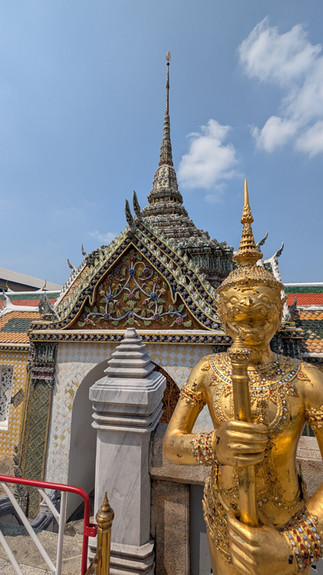


With your ticket to the Grand Palace, you also get a special touristy treat: a chance to watch a piece of traditional Thai theater at the Royal Theater. Traditional stories are typically drawn from Thailand's national epic called the Ramakien. The Ramakien is adapted from a Hindu epic called the Ramayana. This is a fascinating example of how different religions and scriptures have influenced each other throughout history. In the original Ramayana, the main character Rama is an avatar of the Hindu god Vishnu. In the Thai adaptation, Rama is a mighty king figure instead.

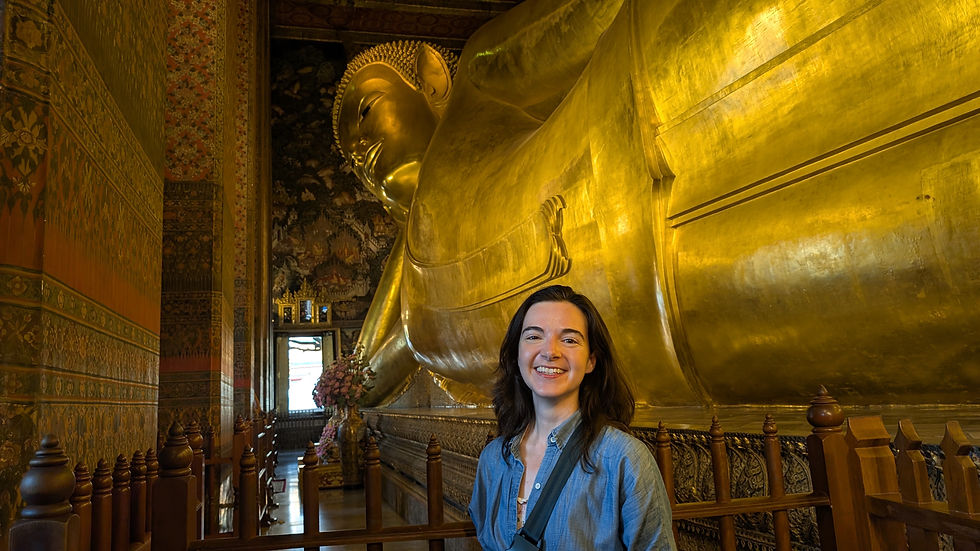
After watching King Rama win a fierce battle on stage, I visited Wat Pho, a temple complex just down the road from the Grand Palace (with a separate admission fee, of course. Those are bigger in Bangkok, too.). The complex contains temples, gardens, a small museum on Buddhist-Catholic relations and traditional Thai massage techniques, and what was easily the highlight of Big Bangkok for me: Big Buddha.

I left the Grand Palace and Bangkok temples with a far greater appreciation for other religious scriptures, which is one of the main goals of my travels. For my own understanding, I've spent the past week comparing the Hindu Ramayana to the Christian Bible in their religious traditions. Much of the differences boil down to how we view the historical truth of the documents and how we interpret (and even change) our scriptures over time to match our changing cultures.
The Ramayana is unique in that while it's considered a deeply sacred scripture, its validity doesn't depend on the preservation or historical accuracy of a single text. Rather, its stories are granted fluidity; they are often adapted and reimagined through different perspectives to best teach the underlying lessons. The essence of the Ramayana is not in the details but in the overarching themes and philosophies that are preserved and passed on through hundreds of variants.
At first I was apprehensive towards the idea of a more fluid scripture, but I've been wrestling with the fact that even when the documents don't change, no scripture is static. How we interpret and apply scripture to our lives constantly evolves as we grow, have new experiences, and learn new information. Fluidity is a necessary grace we have to give any scripture and any scripture-follower. Understanding this fluidity in other traditions can help us build bridges to better connect with our global neighbors and foster a greater mindfulness for how we interpret our own texts. I'll end it there for now, but I'm continuing to chew on this on my own time.
The Transportation Experience
When you visit a new city, you pick up on glimpses of how a government is working to improve the lives of its residents. What stood out immediately to me as the best of Bangkok is its public transportation.
For the most part, Bangkok’s public transportation is efficient, clean, reliable, safe, and — God bless — cheap. Imagine a cleaner New York subway with fewer rats and tracks encased by glass so no one can fall in. Now add a sky train, ferries, water taxis, and a monorail. Basically, whether you want to get somewhere by tracks, wheels, or waves, Bangkok has you covered, and you'll never pay more than a couple of dollars to get there.


Bangkok has aced one test of public policy: how to build public transportation people actually want to take. The government uses taxes to subsidize ticket prices for all, and political parties from both ends of the spectrum continue to propose fare caps and initiatives with one common goal: keeping cars off the roads.

As a result, both residents and tourists can get just about anywhere they need cheaply and without a car, a rarity for most cities in the United States. Even those who don't take the public transportation their taxes pay for still reap the rewards of being part of a subway-centric society: more people on the trains means fewer cars on the roads, which translates to less traffic, fewer accidents, and less pollution. Bangkok's government has even offered free train fares during pollution crises to reduce car emissions and improve air quality for all.
It's a policy soapbox I will die on: when you invest in systems that help individuals at the bottom, the impacts ripple upward, and everyone stands to benefit.
For those at home, just imagine how our morning commutes could change if Texas invested their colossal infrastructure budget into building a network of trains and buses instead of adding another lane to I-35.
It's also worth noting that even on the roads, cars aren't the only option. Here, scooters rule the streets. Although they like to take traffic signals as loose suggestions, they’re a halfway point between cars and pedestrians that improve both individual costs, emissions, and overall traffic. You can order a scooter ride here just like you would order an Uber at home.


(Because I know my mom's reading this, I won’t disclose whether I took one of these scooters. Or a dozen of them. Because they are ridiculously cheap to take and the most fun to ride. Or so I’ve heard. From others shouting “wee” on the backs of their scooters. Definitely not me, Mary.)
The Other Experiences
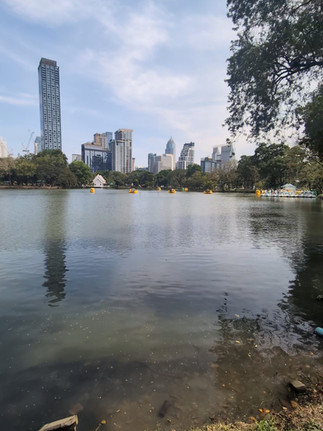
In between the train rides and temple tours, I spent a Sunday biking the roads of Bangkok’s Green Lung, a small island just outside of the city you can reach by water taxi. I also explored the biggest outdoor market in the world, held my own Thai-tea-taste-off in the biggest mall in the country, saw the famous water monitor lizards in Lumpini Park, kicked off Lunar New Year in Bangkok’s China Town, and tried some of the best street food in the world.



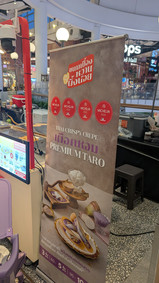
The food part isn't just my opinion - these food stalls have the Michelin ratings to prove it. You'll see the little red Michelin circles for reviewed meals in food courts and street markets all over the city.




I’m also meeting lots of digital nomads who work on their laptops in hostel common rooms. They’re spending their 20s and 30s seeing every corner of the world while working, and their costs of living are significantly lower than if they were living in the states or Europe. While they're making less than I did in the states before I left my job, they're actually able to save more - not to mention they often get to take advantage of better transportation, education, and healthcare systems while they're here.
I haven’t met many people from the U.S. on this side of the world yet, but this week really is a wake-up call of opportunities and pathways I could have never imagined at home, and I'm becoming a bit more aware of the limits I've set on my own future without realizing it.
Next up, I’m trying another form of budget transportation, a 10-hour night bus from Bangkok to Krabi for a few days on the famous Thai islands. Let's hope balance and contentment continue.
Love,
Megan


Hi Meg! I love hearing from you. Thanks for sharing your blog—it’s full of your wonderful experiences. Keep your eyes wide open, absorbing and enjoying God's marvelous creation on the other side of the world. You’re missed back home, girl!