Meg's Adventure Roundup Part 1: Chiang Mai
- Mar 2
- 10 min read
Updated: Apr 2
This week marks the start of an adventure on the other side of the world. I left my job, sold my furniture, and carried a pink backpack through 30 hours of planes and airports to reach our first destination. We're starting 13 hours ahead of Texas in Chiang Mai, Thailand.
Word of the Week
The word of the week is indulgence.
This trip marks the intersection of several turning points in my life. One I'm incredibly excited about is a shift in my career from personal finance to economic policy. Backpacking across a continent is a surprisingly natural way to make this transition — I get to explore firsthand the policies, people, faiths, and economies of our global neighbors and how they impact everyday life. Part of this exploration means practicing slower travel and seeking meaningful moments that pierce beneath the shallow tourist traps.
But I have a tragic confession to make: this week, I indulged my inner shallow tourist.
She wears a fanny pack, eats mango sticky rice from street carts, and books bus tours to watch elephants bathe in a river. She took a selfie with a monk and spends every spare coin in her change purse on grilled bananas.
She was the walking personification of gluttony foreigners expect Americans to be. But this shame comes with a silver lining: she also burned out quickly.
For the first few days, I dove into the kaleidoscopic swirl of experiences that made up “the perfect Chiang Mai itinerary:” eat the pad thai, sip the mango smoothie, walk barefoot through the temples. By all instagrammable accounts, I had the experience.
But after about three days, I realized I had no idea what the experience actually meant. We all want to be surprised and delighted by a new city, but being constantly dazzled by a kaleidoscope requires us to place our full vision through a narrow, hollow tube. That’s certainly what my first few days were: an empty tube of tourism.
As it turns out, no number of grilled bananas could satisfy the real hunger I have for this trip (and I ate many, many grilled bananas). Ultimately, I'm here to connect more deeply with new cities, new people, my faith, and myself. When I landed in Chiang Mai, I was so preoccupied with the need to make the most of my time that I began to measure success in the must-dos, must-eats, and must-sees. Every indulgent impulse within me was given permission to race rampantly through the streets like the running of the bulls.
Moving forward, I’m measuring success in lasting cultural takeaways rather than the number of bucket list items I can check. The last half of my week was a step in the right direction, and I'll keep working toward meaningful, slower experiences as I travel. I guess if I was going to make such a rookie blunder, it's best to catch it in week one.
But make no mistake: I can explore social policy and sip a mango smoothie at the same time. It's a rough job, but somebody's got to do it.
Here are the highlights from my first week. A huge and heartfelt thank you to everyone who has been sending prayers, messages, and warm wishes my way. I hope this gives you a glimpse into what I've been up to, and thanks for coming along for the ride.
A Little About Chiang Mai
Chiang Mai is in northern Thailand, where you’ll find mountains, waterfalls, and more than 300 Buddhist temples (I made it to about 10). It’s the second-largest city in Thailand (after Bangkok), and it’s known as the cultural center of the country, despite being pretty far from the actual center.

Where I Stayed
For the first stretch of my trip, I’m staying in hostels. These are basically dorm-style bunk beds where you and all the other backpackers of the world come together to share a room. The fun part about hostels is that you get to learn a lot about people from every part of the globe. The drawback is that you also learn how they sleep, snore, sneeze, shower, and occasionally what brand of underwear they wear. It’s like adult summer camp, except some of the campers are hungover and no one wakes you up at 7 a.m. singing, “Rise and shine and give God the glory, glory.”
Right now, I’m booking hostels for 2 to 3 nights at a time. This allows me to explore different parts of the city and different types of hostels. Like just about anything in life, you really have to try a sampler to learn what you like and what to look for.
The Chiang Mai Experience
Now for what you came for: The Experience. I stayed in a part of Chiang Mai known as the Old City, which is exactly what it sounds like. The Old City was a goldilocks size for me: big enough to never be bored but small enough to walk where you need and feel familiar after a few days.

Pro traveler’s tip! Stay in walkable areas and walk everywhere you can to burn calories and make room for more grilled bananas.
If Chiang Mai had to be boiled down to one building, it would be a temple. These magnificent structures are planted across the city as abundantly as the 7/11s - you can’t walk down the street without running into one of each. But there’s no time to explore all 300; I started with the “must-see” larger temples and slipped into several smaller ones I found along the way.
There are some ground rules for temple touring. First, visitors must take off their shoes before entering a temple. (On my second day, I walked into one particular temple where a group of about 60 school boys were seated barefoot on the floor after walking all day in the hot city. That room was ripe.)

Women have to cover their shoulders and knees, which means that most days I couldn't wander into a temple I found off the streets. I had to designate specific temple days where I wore a longer skirt and sleeves. Some temples still forbid women from entering altogether.
While each temple is home to a unique image of the Buddha, they share one quality: displays of lavish extravagance in both the temples themselves and the offerings within them. Thousands of crystals adorn chandeliers that seem to float on the ceilings. Gem tones in the windows refract the light and cast a magnificent glow over golden and emerald Buddhas. Every detail, down to the last tile, has been meticulously curated to honor a particular Buddha image.
I found that regardless of faith or familiarity with Buddhism, the temples impart a remarkable and almost convicting appreciation for the word worship. These sacred spaces are a visual representation of one message: to worship is to generously outpour our first fruits to our deity. (In many temples, this is literal. The actual best grapes and individually wrapped apples from the markets were placed on the altars.)


While I don’t feel compelled to start offering fruits to my church at home or replace our sanctuary lights with chandeliers, I have been considering what it truly means to offer my first fruits to my own God. Money is one of the most impactful ways to express worship and awaken a static faith into action. What does a radical generosity and worship expressed through money look like for me? It's something to ruminate on every time I step foot into a temple.
I came to Thailand knowing little about Buddhism itself. Aside from admiring temples simply as pieces of architecture, I wanted to learn how to appreciate them in the context of the religion and community. On my second day in the city, I took advantage of a special opportunity to learn more about Buddhism at a temple called Wat Chedi Luang through a monk chat.
The Monk Experience
Some temples open their courtyards and allow you to sit and talk with a monk during certain hours of the day. You get to learn more about monks and Buddhism, and the monks get to practice their English. Win-win.
I spoke with a hilarious monk named Pooh for about an hour. We started with the usual questions: Why did you become a monk? How long have you been a monk? I was expecting a conversation centered around personal enlightenment, but we never touched the topic. Instead, he told me he decided to become a monk because his parents wanted him to. It’s apparently pretty common; across borders and religions, a lot of people do a lot of things in the name of making their parents proud.
He also told me that men often become monks for economic and social reasons. Before education was free in Thailand, the only way for children from lower-class families to get a respectable education was to join the monkhood. (Monkhood? Monkmanship? The monastic life.) Even today, a monk’s education can be used to climb educational and social ladders. For example, Pooh said he always struggled in school (he showed me the "0% F" equivalent he received in English in primary school), but he is now earning a degree in English for free.
We talked about monk life for a few minutes, but monks, like all of us, contain multitudes. I learned Pooh is a big fan of Japanese anime, and we spent much of our time talking about Dragon Ball Z and swapping show recommendations on his phone. I asked him what he thought of Americans; he said we drink for every occasion. (“You sad, you drink. You happy, you drink.”) He said I have bad taste in TV shows. He joked with his friends in the courtyard. He told me if a monk achieves a level of consciousness that allows him to see into the future, it's strictly forbidden to tell anyone. He asked me for a selfie for his English class portfolio. I asked him for a selfie for my mom.

While I didn’t learn much about personal enlightenment, I did gain empathy and depth for the previously 2-dimensional figure I called a monk. And at the end of the day, what greater purpose can an adventure have than developing greater understanding and love for another person?
On my last night in Chiang Mai, I took an evening tour of two of the most famous temples: Wat Pha Lat, a jungle temple on a winding mountain outside the city, and Wat Phra That Doi Suthep, the most famous and extravagant temple in Chiang Mai. (According to every guide on the internet, “If you’ve been to Chiang Mai but haven’t been to Wat Phra That Doi Suthep, you haven’t been to Chiang Mai.”)
I went with a tour group, led by a local guide who explained more about the architectural features and Buddha images within the temple. We visited around 6 p.m., where we walked 306 steps to the top of the temple and arrived just in time to witness the temple’s monks and followers begin their evening chants.
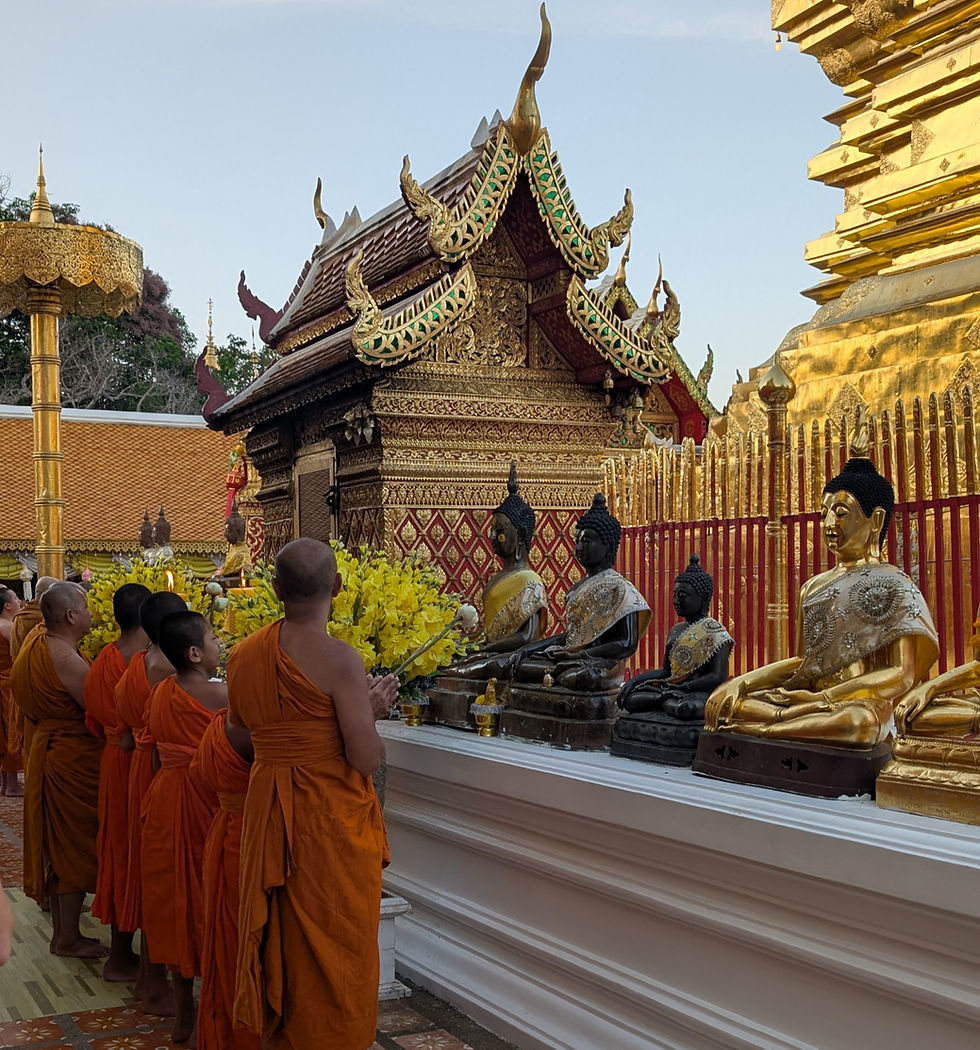
Especially without a guide, it's hard to learn about Buddhism through temples alone; signage is usually limited and only written in Thai (which is fair enough, we're in Thailand). While I left most temple visits with a greater understanding of and appreciation for Buddhism, I also know I barely scratched the surface of each temple's significance to the religion and community. This week, I’m diving into more research on Buddhism so I can better appreciate the temples in the rest of Thailand and understand how religion plays a role in regular life for the majority of the country. I’ll be sure to share what I’ve learned.
The Elephant Experience
As much as I want to push the tacky tourist away, you can’t visit Chiang Mai without seeing some elephants. There’s nothing local or hidden about this: total tourist trap. Totally loved it.
I visited an elephant sanctuary with a small group where we got to learn about Asian elephants, their sacredness in Theravada Buddhism (following elephant paths were how monks decided where to build the famous mountain temples), and — my favorite part — how to feed them some yummy snacks.


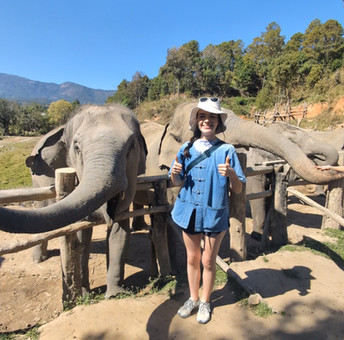
Our elephants were primarily rescued from logging companies and are now free to roam on a 50-acre sanctuary. So how do you get six elephants with free will to congregate at one fence for a group of tourists to take pictures?
You strategically visit at feeding time.
All visitors are given the same denim overshirts to wear that signal to the elephants, I have bananas. The elephants know the drill and happily gathered around the fence for a treat. While there are a lot of qualities I would like to share with an elephant (like kindness, strength, and empathy) right now our greatest commonality might just be how willingly we will trot somewhere for a free banana.

The Nature and Tea Experience
One of the most beautiful mountainous spaces in the country, Doi Ithanon National Park, sits about two hours away from the Chiang Mai. As a solo female in a new country, I wasn’t about to take my first hiking experience alone (you're welcome, mom), so I booked a group tour for this one.
We visited the national park where we explored the summit (which included two beautiful temples and a garden with an incredible view over the mountains). From there, it was only a quick walk to the highest point in Thailand, and it was all downhill from there. We hiked for about an hour and a half through the mountains, past waterfalls, across rice and coffee fields, and over bamboo bridges until we reached the nearby Karen Village.


This village of about 400 people relies primarily on tourism for income. While the area used to be a key producer of opiate (and they were sure to play that joke up), we were able to see their homes, school, and what they’re most known for, their coffee beans. We ended our journey at their cafe where we sampled their specialty coffees and teas made from the beans and leaves they grow.
I’ve felt a bit ambivalent about visiting people and places whose livelihoods fully rely on catering to tourists. I’m exploring the cogs of this economy on the side as well, so stay tuned for an update!

In between all of this, I was also able to experience Chiang Mai’s flower festival (including the annual parade), the famous night markets, my first boy band concert, and the “must-eat" dishes (the highlights were khao soi curry, pork leg with pickled cabbage from a local legend called the Cowboy Hat Lady, sour sausage, and mango sticky rice). I'd estimate my bloodstream is about 70% Thai tea and mango juice at this point.
While it was fun for a week, this indulgent, rushed form of tourism isn’t sustainable. Even if it were, I wouldn’t enjoy myself if I kept this up for much longer. My inner tourist has had enough tour guides and selfies for a minute. Now it’s time to slow down and start some more meaningful adventures.
In total, I spent 7 nights in Chiang Mai. Up next, I’m boarding a 13-hour train where our adventures will continue in Bangkok.
See you soon. Love,
Megan


I like the Kaleidoscope comparison of the typical tourism experience, and your pursuit to see outside of that kaleidoscope. And the description you have of the temples paints a picture that the photographs I've seen over the years haven't been able to capture. Love what you have so far! And, yes...grilled banana recipes are being tested now 😀
Welp, looks like it's time to learn how to grill some bananas or we may lose this gal forever. 🥰
Love it! Thank you for sharing your adventures and insights, Megan. I'm looking forward to your next installment. Love you and am praying for you.
Your journaling is far more comprehensive than what I did in the past. Love what you are posting. I’m living vicariously through your trip. What else are we going to do?😇
WOW!!! I am just thrilled to see you and hear how you’re doing, Megan! It’s so fun to read all about your adventures and all you are learning. You write so beautifully and engagingly! I feel like I’m there with you. So happy you have this time. Continuing to miss you think of you and pray for you often <3